


sustainability and legality

Smalterie Vicentine is fully compliant with regulations on the use of banned substances such as nickel, cadmium or lead and other heavy metals, which have been eliminated.

Purification plants have been in use since 1973 and the water used for pickling is taken from a well owned by the company, only partly supplemented by mains water. After use, the water is purified and released into the drainage system in compliance with parameters laid down by the Veneto Regional Agency for Environmental Prevention and Protection (ARPAV).

Spraying residues, particularly those produced by the wet process, are recovered, classified with the appropriate EWC codes and disposed of by certified companies.

All enamels come with technical data sheets and safety data sheets. Since the enamels are subject to M.O.C.A. regulations requiring surfaces that come into contact with food to be compliant with relevant standards, the products are safe inside and outside the home. Enamel does not release toxic substances.
CLIMATE POSITIVE 

Science, innovation and good governance to tackle the climate crisis and leave a better world than the one we found

M.A.R.C. a serious path exists:
the path that Smalterie Vicentine has undertaken in 2022 with the support of Etifor, a spin-off of the University of Padua with B Corp certification.

Measure: Calculate and verify your impacts
Avoid: Avoid and reduce your impacts
Risks: learning to manage new climate risks
Communicate: Capture your impacts and communicate with trees

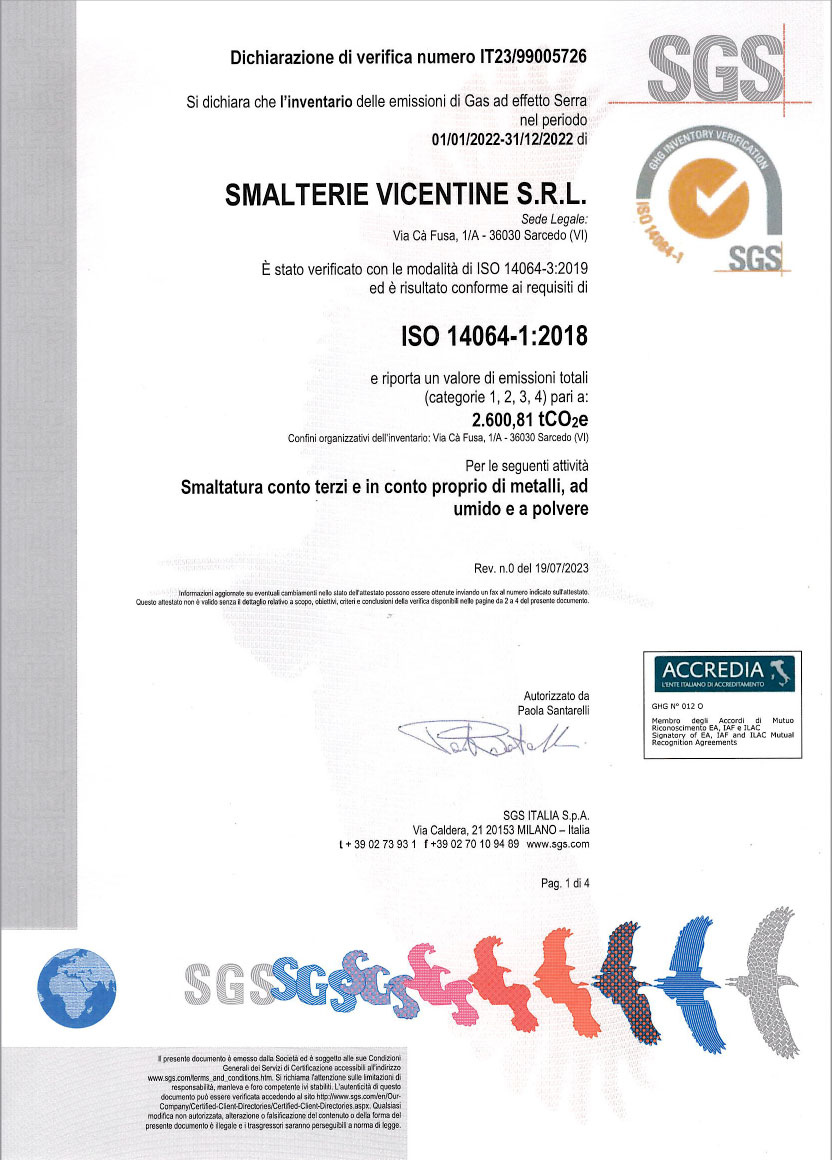
1) The first step of the project, which involves the measurement of impacts, has just been concluded for this year, through the 2022 emissions measurement process and the certification of the CFO (Organization Carbon Footprint Certification) according to the ISO14064 standard.

2) the emissions reduction plan, Climate Positive List, has begun with the installation of solar panels on the roof of the enamelling for 500 kW of photovoltaic.
The identification of technical and organizational solutions to reduce its climate impacts continues through investments in the company and in its supply chain, supported by a participatory process to be monitored every year.

3) The analysis of physical and transition climate risks and finally the compensation that is made every year on a percentage of emissions has the objective of reaching 2040, the year in which 110% of residual emissions will be compensated.